The Sleep Journals
Research, data, and field notes on sleep, hospitality, and the growing sleep tourism economy.
For Guests
For Guests
Property Success
For Guests
Property Success
Science & Methodology
For Partners
For Partners

For Partners
For Guests
For Guests
Property Success
Property Success
Sections
Straight answers to what actually determines how you sleep away from home.
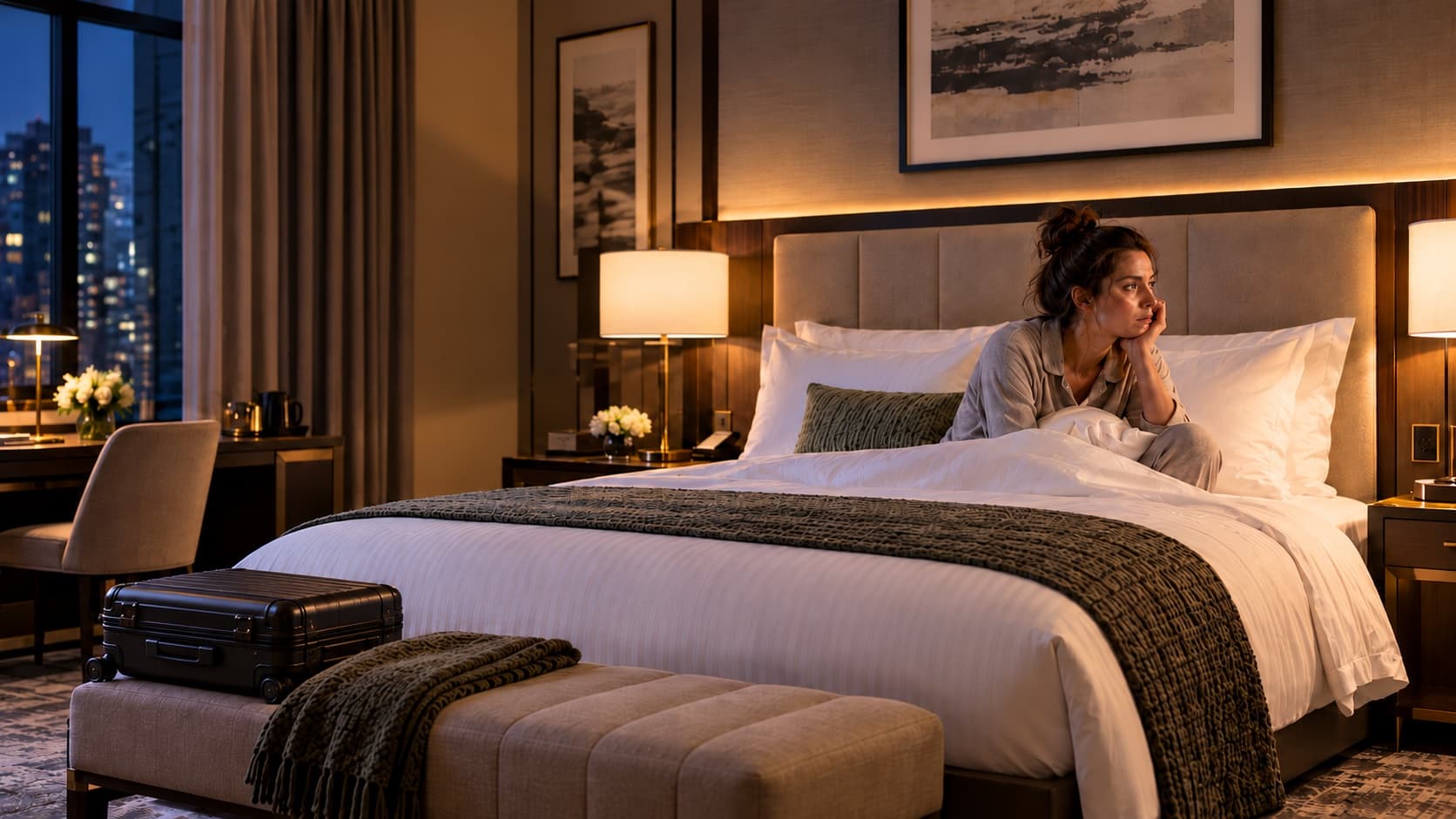
Difficulty sleeping in hotels is common and usually has two separate causes. The first is the "first-night effect": in an unfamiliar environment, one hemisphere of your brain stays partially alert, acting as a night watchman. It's a survival reflex, it's involuntary, and it typically fades by the second night. The second cause is the room itself: noise leaking through walls and doors, light around the curtain edges, a temperature you can't control, and bedding that doesn't suit you. The first cause is biology and you can't negotiate with it however, friendly staff, good security and safety perception and natural flow of the room can reduce this effect. The second is more technical. Both are just invisible when you book, which is why we score properties across all 14 dimensions before you ever see the room.
The first-night effect is a well-documented phenomenon in which people sleep worse on their first night in a new place. Sleep research has shown that one hemisphere of the brain remains more vigilant than the other, monitoring the unfamiliar environment for threat. It means lighter sleep, more awakenings, and less deep slow-wave sleep. It's the reason a single-night business trip is often the worst sleep of the month: you leave before your brain has decided the room is safe. You can't switch the reflex off, but you can give it less to react to: secure and natural feeling room with a genuinely quiet, dark environment gives the night watchman less to watch.
The recommended range for sleep is roughly 15–19°C (60–67°F), cooler than most people set their rooms. Your core body temperature needs to drop by about 1°C to initiate sleep, and a warm room prevents that. The catch is that many hotels lock the thermostat range centrally, so the number on the wall is decorative, which is why our scoring checks whether guests can actually set their own temperature, not just whether a thermostat exists. If you're stuck in a locked room, the workarounds are a cooler shower before bed, stripping the heavy top layer of bedding, and running the AC before you go out to dinner so the room is already cold when you get back.
The WHO guideline for undisturbed sleep is around 30 dB of continuous background noise, roughly a whisper. More important than the average, though, are the peaks: sudden noises above about 45 dB, like a door slamming or a hallway conversation, trigger measurable arousals even when you don't consciously wake. This is why a steady hum can be tolerable while one slammed door at 3am ruins the night, and why white noise works: it masks the transients rather than removing them. Both matter, which is why soundproofing, HVAC noise, and hallway discipline are scored separately, and why monitored rooms track the spikes rather than just the average.
Yes. Light penetrates your eyelids and reaches specialized retinal cells that regulate melatonin, so darkness matters even when you're asleep. A 2022 Northwestern study found that a single night in a moderately lit room, around 100 lux, roughly a dim overhead light, raised nighttime heart rate and impaired next-morning insulin sensitivity compared to sleeping in near-darkness. Hotel rooms are particularly bad for this. The problem is rarely the curtains themselves; it's the gap where they don't quite meet, the glow under the door, and the standby LEDs on the TV and router pointing at the bed: small enough that nobody mentions them, bright enough to matter.
One common and overlooked cause is carbon dioxide buildup. A closed hotel room with weak ventilation can climb from around 400 ppm at check-in to 2,000+ ppm by morning as you breathe. Above roughly 1,000 ppm, air quality is considered poor; above 1,400 ppm, research shows measurable effects on sleep quality and next-day alertness. It's the most invisible problem in hospitality: an inspector walking the room at 2pm sees perfectly fresh air, while the guest at 5am is breathing something very different. It's also the clearest argument for measuring rooms overnight rather than once.
The room factors you can't see in a photo: noise through walls and doors, light leaks and standby LEDs, whether you can actually set the temperature, bedding that fits how you sleep, and overnight air quality. Star ratings measure the lobby and breakfast; Sleep Grade scores those 14 dimensions across four phases of your sleep — settling in, falling asleep, staying asleep, and waking up — because those are what decide how you feel the next day.
Not reliably. Star ratings measure the lobby, the spa, and the breakfast: none of which touch the eight hours that determine how you feel the next day. An expensive room on a busy street with a locked thermostat can sleep worse than a modest one with proper blackout curtains and a quiet corridor. The factors that actually matter are largely invisible when you book, which is the entire reason a separate sleep score exists: photos and price are poor proxies for rest.
Not necessarily. "Hypoallergenic" is an unregulated marketing term with no standard definition, so it can mean anything from a synthetic pillow to nothing at all. What genuinely reduces allergen exposure is specific and checkable: HEPA filtration, humidity held between 40–50% (dust mites can't thrive below 50%), linens washed at 130°F/54°C or hotter to break down mite allergens, sealed mattress and pillow encasements, and fragrance-free cleaning near the bed. Those are the things worth asking about, and the things worth scoring, because if a property can't tell you which of them it does, the label on the door doesn't mean much.
Recovery is slower than most people assume. A single night of poor sleep measurably affects next-day attention, mood, and decision-making. Yale Medicine notes that sleep-deprived people take longer to make decisions, and those decisions tend to be less accurate. And the deficit doesn't clear with one lie-in: research suggests it takes two to three recovery nights to fully resolve. For travelers, that's the real cost: bad nights compound. The first-night effect on Monday plus a noisy room Tuesday means Wednesday's meeting is the third straight day of impairment, not an isolated bad morning. Most trips don't have three spare nights, so the only real defense is not losing the first one.
Research, data, and field notes, occasionally, not constantly.