Key Takeaways
Sleep is one of the largest investments of time we make throughout our lives, yet we often leave its quality to chance.
A good sleep environment involves more than a comfortable bed. Noise, light, temperature, air, bedding, and hotel operations all deserve attention.
For travelers, poor sleep can affect the next day. For hotels and enterprises, it can also affect satisfaction, performance, and business outcomes.
Sleep Grade brings assessment, improvement, training, and monitoring into one platform to help make sleep quality easier to understand and improve.

Article FAQ
To help travelers understand accommodation sleep conditions and help properties improve them.
Guests can freely compare property profiles, sleep scores, available badges, and guidance before their stay.
Bronze is a starting benchmark, Silver adds evidence review, and Gold adds ongoing monitoring of individual rooms.
Our Most Valuable Investment
The most prized item anyone has is time. A 75-year-old has already lived through a little more than 27,000 days. How many were refreshing, and how many were an absolute, leg-dragging nightmare? Only they know.
Do you remember your last good sleep? How refreshed you felt afterward? How it colored your day, and how nice the morning was? Some people really focus on this experience, and it is worth focusing on.
Good sleep supports health, attention, memory, and mood. [1] It also helps us work through problems. In one controlled study, more than twice as many participants discovered a hidden rule in a task after sleeping as after staying awake. [2] That is a result from a specific experiment, but it gives real meaning to the advice to "sleep on it."
In an era of AI, we believe a rested mind may become an even more valuable asset.
Sleep, or sleep-like behavior, occurs across a wide range of animals, including species with very simple nervous systems. [3] It is nature's way of washing away the day and preparing for new experiences.
There is little need to explain the experience of sleep to anyone. Billions of people invest hours of their time in it every night. Yet that investment is often made with an educated guess, without useful data, and without much thought about how to improve it.
Why Do We Still Leave Sleep to Chance?
Our understanding of sleep continues to improve. Still, on an individual level, we may spend more time finding a small recipe change for slightly more delicious food than understanding how to improve our nightly cognitive voyage.
We know what a good meal tastes like. Understanding why a night's sleep was good or bad can be much harder.
Insufficient sleep is a widespread public health concern. The CDC reports that about one-third of U.S. adults do not get enough sleep. [4] That is a U.S. estimate, rather than a global measure, but it illustrates the scale of the problem.
Not only do we leave sleep to chance; unless we work in the field, we often do not know how to improve it.
We know some basics: quietness, darkness, a comfortable bed, and avoiding a heavy meal before bedtime. But these are pieces of a much larger puzzle. Research identifies several environmental factors that influence sleep, including noise, light, temperature, and air quality. [5] They interact with our health, routines, stress, and personal preferences.
At Sleep Grade, we believe personalized sleep guidance will become an ordinary part of daily life. In the not-so-distant future, having an AI-powered personal sleep coach may feel as normal as having sports shoes in your wardrobe.
The Room Is Part of the Puzzle
Monitoring individual physiology is only part of the picture.
A wearable can tell you something about your night. Understanding the room can help explain what may have disturbed it and what could be improved.
Internal and external factors interact, so assigning a universal percentage to each would oversimplify sleep. But the sleeping environment clearly deserves attention. [5]
Compared with the wider study of sleep medicine and biology, sleep in hotel rooms remains relatively underexplored. Researchers studying hotel guests have highlighted this gap. [6] Bedrooms, beds, linens, ventilation, architecture, and operating practices vary widely, making consistent assessment difficult.
A good mattress matters. So does what happens around it.
Buying a Room Should Not Feel Like Buying a Lottery Ticket
For people sleeping away from home, the question becomes harder.
Every night, travelers settle into paid accommodation with unfamiliar beds, unfamiliar sounds, and unfamiliar room controls. The first-night effect adds another challenge: research suggests that part of the brain can remain more vigilant when sleeping in an unfamiliar environment. [7]
Hotels, hostels, and other accommodation providers share a basic promise: a place to sleep. Yet travelers rarely have a consistent way to compare how well those places support rest.
Sleep Grade currently tracks more than five million properties for sleep performance. Our aim is to make that comparison easier to understand.
Without useful information, travelers go to bed unsure whether their next several hours—and the day that follows—will feel like a thunderstorm or cotton candy.
“When we rent a room without understanding its sleep conditions, we are buying a small lottery ticket that can cost us the next 24 hours.”
For Hotels, Sleep Is a Business Question
For hotels and other short-term accommodation providers, sleep is also a business question.
A study of 609 frequent travelers found that sleep satisfaction was a strong predictor of overall hotel satisfaction. Uncomfortable pillows, uncomfortable bed linen, and sound from air conditioning or heating were associated with poorer guest sleep. [6]
Our view is that better sleep gives guests another reason to remember a property positively, recommend it, and consider returning. For an industry that invests heavily in marketing and loyalty, that is a meaningful opportunity.
The industry already understands the value of the guest experience. That is why loyalty programs, specialized customer services, review analytics, pricing systems, and targeted marketing exist.
However, those tools cannot prevent a guest from waking at the deepest hour of sleep because of a rattling AC unit. They cannot resolve an overwhelming room fragrance, or replace staff who know how to handle a sleep-related complaint in the middle of the night.
The experience must be delivered in the room.
For Businesses, the Consequences Go Further
For leisure travelers, poor sleep can spoil a day. For people working in roles that require sustained attention, it can create more serious consequences.
The Federal Aviation Administration identifies fatigue as a flight-safety hazard and explains that lack of sleep can reduce coordination and alertness. [8] Rest matters for pilots, drivers, captains, machine operators, healthcare professionals, and others whose work depends on sustained focus.
For a corporate account manager, a bad night in a hotel may have less dramatic consequences. But arriving tired for a customer visit, negotiation, or important presentation can still affect performance.
We see this as a business reason to examine accommodation more carefully. The room is part of the conditions in which a traveling employee prepares for the next day.
Why Sleep Grade Was Born
As frequent travelers and hotel sleep survivors ourselves, these are the reasons we started Sleep Grade.
Our ambition is to make Sleep Grade a global sleep assurance standard for the places where people sleep.
As we move toward that goal, travelers should gain a clearer understanding of how a particular place supports their rest—and, through that, the day that follows.
Sleep Grade integrates assessment, sleep assurance, monitoring, and improvement into a single platform powered by AI.
The goal is practical: make sleep conditions easier to understand, identify what needs attention, and help properties improve them.
From Assessment to Improvement and Monitoring
First, drawing on published sleep research and the input of scientists working in the field, we designed an assessment framework covering 14 sleep dimensions.
Our algorithm and AI engine process available aggregated property information across a database of more than five million properties. The framework turns that information into structured insight about the sleep environment.
We then developed analytics tools and reports for hotels, tourism properties, and enterprises that use accommodation or work with accommodation providers, including airlines.
The aim is to pinpoint problems and distinguish straightforward fixes from more demanding improvements. Both can make a meaningful difference to the guest experience.
With our scientific advisors, we designed improvement roadmaps and training packages to help hotel staff build awareness and learn practical ways to support guest sleep.
Finally, drawing on years of AI and IoT experience, we developed our sleep environment monitoring platform. It supports IoT sensors and measurements collected by specially trained hotel staff, according to the property's needs.
Together, these capabilities form a continuing process: assess, improve, train, and monitor.
Our aim is to make the assessment understandable and its basis clear. We explain the framework, evidence levels, and interpretation of scores in our Scientific Disclosure. [9]
What Travelers Can See
At www.sleepgrade.com, travelers can freely search property profiles in a list or on a map.
A profile brings together the information available for that property: its scores, any badges earned, its data level, what to verify before check-in, and practical guidance for the stay.
The purpose is to help travelers make a more informed choice and ask better questions before they arrive.
The depth of an assessment depends on the type, amount, and quality of information available about the property or room.
What the Badges Mean
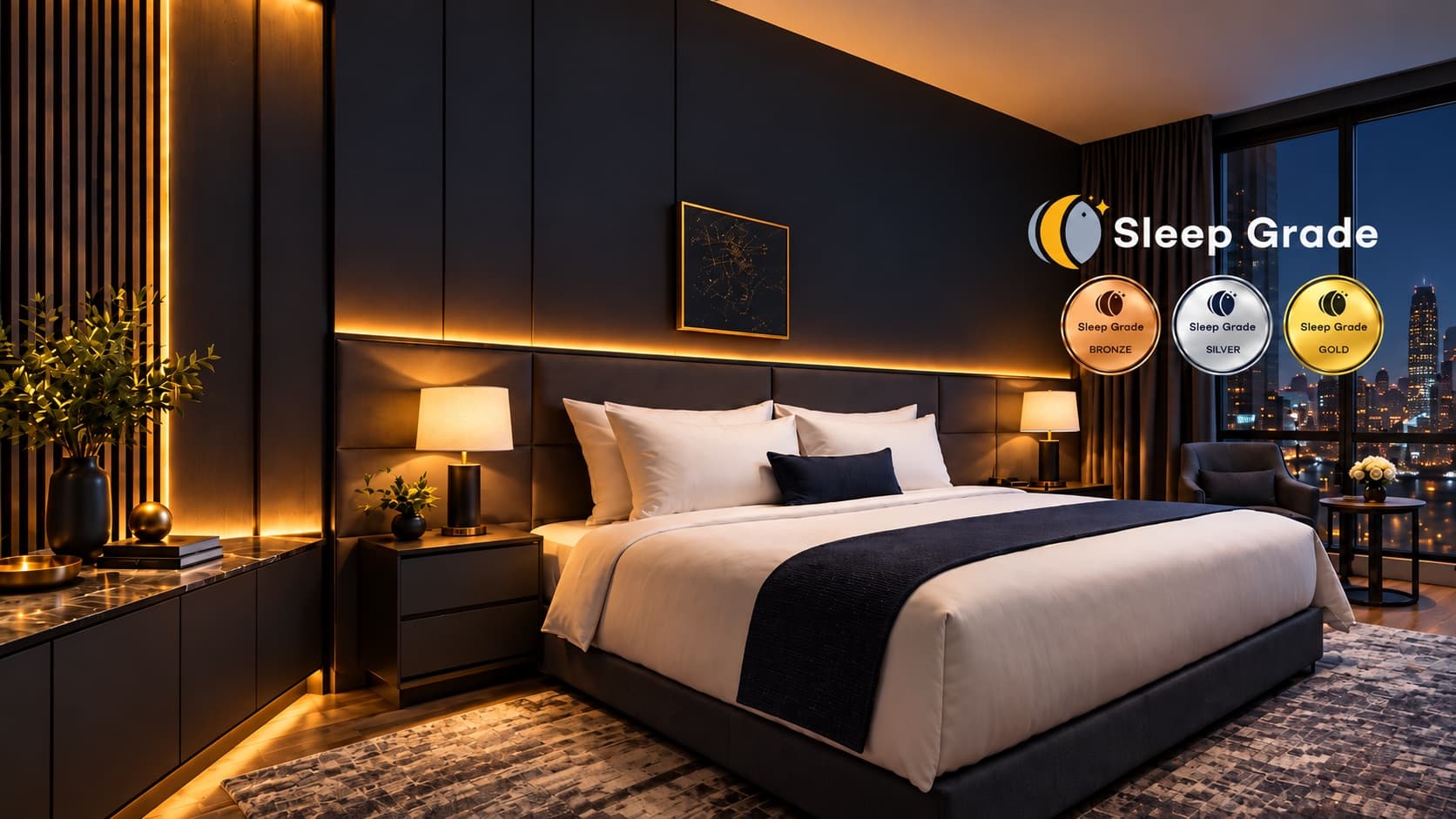
Sleep Grade provides three main badges: Bronze, Silver, and Gold. They represent different levels of assessment and verification.
A public-data baseline score is separate from certification and carries no badge. [9]
Bronze: A Starting Benchmark
Bronze uses self-assessment and/or public information. It is a self-declared starting benchmark rather than an independently verified assessment. [9]
Silver: An Assessment Checked Against Evidence
Silver requires supporting evidence reviewed by Sleep Grade. It is an independently checked assessment at the property level. [9]
Gold: Ongoing Monitoring of a Specific Room
Gold applies to individual rooms and adds continuous environmental monitoring. [9]
The aim is a continuing commitment to maintaining an environment that supports good sleep. Individual sleep also depends on personal factors. [9]
Badges can be earned through qualifying free assessment routes or through a related premium Sleep Grade service, subject to meeting the requirements of the relevant tier.
A Small Improvement, Multiplied Across Millions of Nights
We work in this detail because sleep takes up such a large share of a person's lifetime.
It is a daily investment that continues through childhood, working life, and older age. Improving that investment matters.
As Sleep Grade grows and evolves, our ambition is to improve people's lives a little at a time: a quieter night, a more comfortable room, a better morning, a more focused day.
A small improvement becomes a huge deal when multiplied across millions of nights.
Summary
Sleep is one of our largest investments of time, and the place where we sleep helps shape the return on that investment.
For travelers, clearer information can support better choices. For hotels, better sleep conditions can support a better guest experience. For enterprises, accommodation deserves attention as part of employee rest and readiness.
Sleep Grade was built to connect those needs through assessment, improvement, training, and monitoring—so a good night's sleep becomes something we can understand and work toward.
Sources
- CDC — About Sleep. Guidance on sleep duration, sleep quality, health, attention, and memory. Read the resource.
- Wagner, U., et al. (2004). "Sleep inspires insight." Nature, 427, 352–355. A controlled experiment examining sleep and discovery of a hidden rule. Read the study.
- Keene, A. C., & Duboue, E. R. (2018). "The origins and evolution of sleep." Journal of Experimental Biology, 221, jeb159533. Read the research review.
- CDC — Sleep: Chronic Disease Indicators. U.S. insufficient-sleep estimates and associated health concerns. Read the resource.
- Caddick, Z. A., et al. (2018). "A review of the environmental parameters necessary for an optimal sleep environment." Building and Environment, 132, 11–20. Read the research review.
- Robbins, R., Grandner, M., Knowlden, A., & Severt, K. (2021). "Examining key hotel attributes for guest sleep and overall satisfaction." Tourism and Hospitality Research, 21(2), 144–155. Read the study.
- Tamaki, M., Bang, J. W., Watanabe, T., & Sasaki, Y. (2016). "Night Watch in One Brain Hemisphere during Sleep Associated with the First-Night Effect in Humans." Current Biology, 26(9), 1190–1194. Read the study.
- Federal Aviation Administration — Medical Facts for Pilots, Fatigue. Guidance on fatigue, alertness, coordination, and rest. Read the resource.
- Sleep Grade — Scientific Disclosure & Terms of Interpretation. Methodology, baseline scores, verification tiers, and score interpretation. Read the disclosure.