Key Takeaways
Hotels renovated in 2023–2026 scored 8 to 9 points higher on mattresses, linens, pillows and cleanliness than similar hotels renovated earlier.
On noise, temperature, light and air, they scored only 1.0 to 1.6 points higher.
Hotels opened since 2021 led older hotels on both: about 9 points on the bed and 6.5 to 8.6 points on the night.
The bed lift fades: hotels renovated in 2019–2022 kept only about 1.4 points of it.

Article FAQ
In our data, mainly the bed: mattresses, linens, pillows and cleanliness. Noise, temperature, light and air barely moved.
Based on our data, we can only guess. A soft-goods renovation replaces what guests see and touch, while noise and temperature depend on walls, doors, windows and air-conditioning, which usually sit outside a soft-goods package.
In our snapshot, hotels renovated four to seven years ago kept only about 1.4 points of the bed advantage.
No. Sleep Grade's baseline scores draw on published property information and guest-review evidence. They are separate from independently verified assessments.
Hotels renovate on a rhythm. Before 2020, according to JLL, soft goods were typically replaced every 5 to 7 years and full renovations came every 11 to 14 years. Sleep Grade asked a simple question: what does each cycle do for the guest's night?
We took the review-qualified hotels from our Hotel Sleep Quality Report 2026 that list a renovation year and compared them with similar hotels in the same country and star rating. After removing impossible dates and new-build listings, 2,951 hotels remained: 761 renovated in 2023–2026 and 2,190 renovated earlier.
A renovation buys a better bed
Recently renovated hotels scored clearly higher wherever guests touch the room. Compared with similar hotels renovated earlier, they led by 9.0 points on linens, 8.7 on mattresses, 8.5 on cleanliness and 8.1 on pillows.
The bed
Mattresses, linens, pillows and cleanliness
The night
Noise, temperature, light and air
Guest rating
Overall rating, 10-point scale
The night barely moves
On what happens after the lights go out, the gain was small: soundproofing and corridor noise +1.6, air quality and blackout +1.5, air-conditioning noise +1.1 and thermostat control +1.0.
That matters, because the night is where guests lose sleep. A 2021 study of hotel guests found the strongest drivers of poor sleep were a noisy air conditioner, uncomfortable linens and pillows, and outside noise. Renovations addressed two of those four. J.D. Power also lists quietness and room temperature among the top five contributors to sleep quality.
New buildings show what's missing
Hotels opened since 2021 show what a fuller answer looks like. Against similar hotels opened in 2010 or earlier, they led by about 9 points on the bed and by 6.5 to 8.6 points on every night condition, from air-conditioning noise (+6.5) to air quality (+8.6).
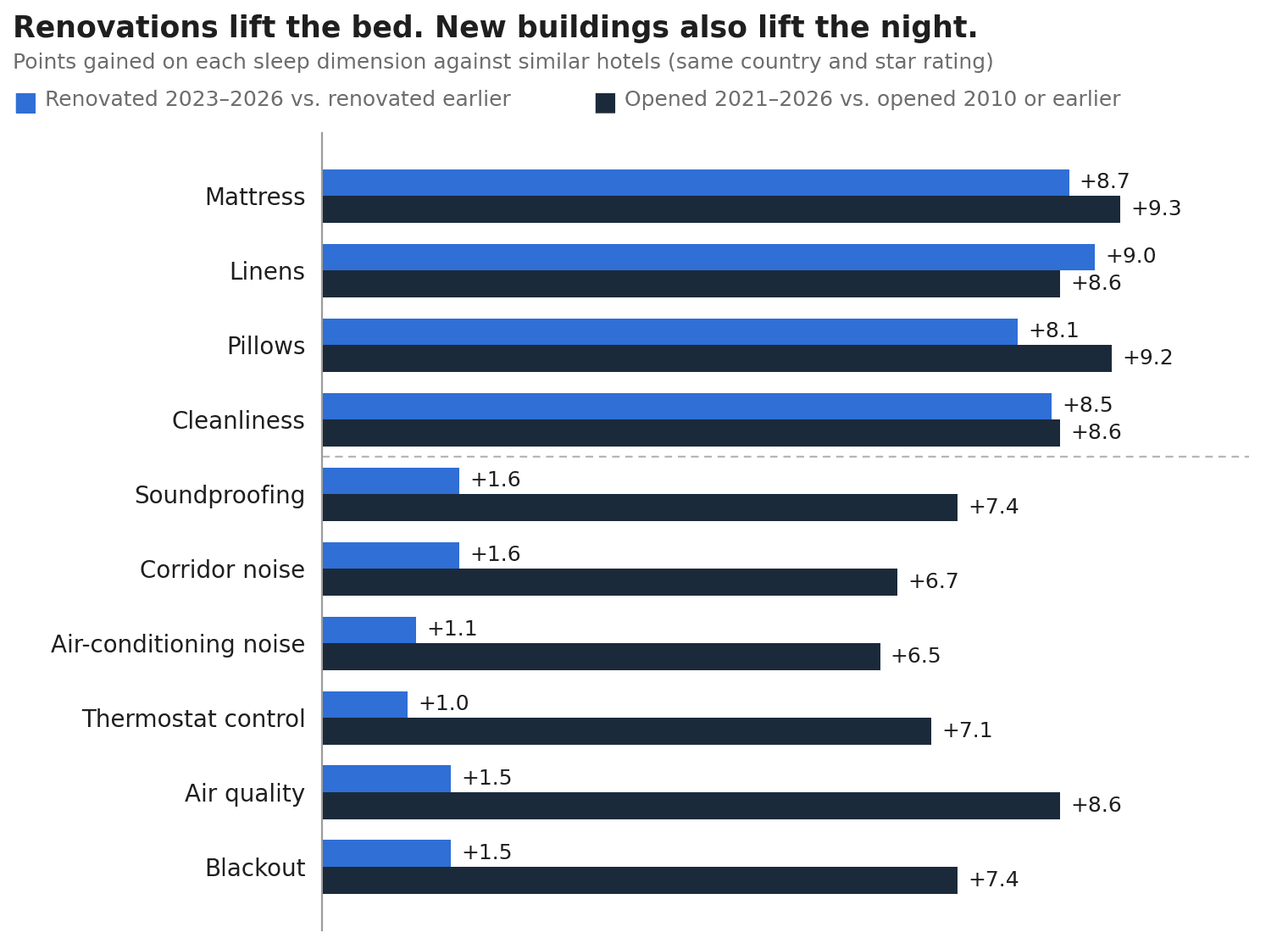
Renovations lift the bed. New buildings also lift the night.
Sleep Grade Research, 2026 · same country and star rating; 2,845 hotels for renovations, 2,696 for opening years
The difference is scope, not effort. New buildings get new walls, windows, doors and air systems; a soft-goods renovation usually does not.
The bed lift fades
The renovation advantage is also short-lived. Measured against hotels last renovated in 2014 or earlier, hotels renovated in 2023–2026 led by 8.4 points on the bed. Those renovated in 2019–2022, four to seven years ago, led by only 1.4.
That fits the typical 5-to-7-year soft-goods cycle: by the time the next one arrives, most of the bed lift has gone. Pillows wear faster still; most experts recommend replacing them every one to two years. Because these are different hotels at different points in their cycle, treat this as a pattern, not a stopwatch.
How to make the next renovation buy a better night
1. Put the night into the scope. Before signing off a soft-goods PIP, ask what it does for noise, temperature, light and air. Door seals, quieter air-conditioning units, full-width blackout tracks and in-room temperature control often sit outside the package.
2. Specify for sleep, not just looks. Choose drapes for blackout performance and mattresses and pillows for comfort and durability, and test a model room at night before ordering for the whole hotel.
3. Protect the bed lift between cycles. Replace pillows every one to two years and audit mattresses and linens annually rather than waiting for the next renovation.
4. Measure before and after. Record your sleep scores by dimension before work starts and track them against your competitive set afterwards. Our scores work at property level; pinpointing problem rooms takes an on-site check.
5. Make the invisible work visible. Guests can see a new headboard in your photos; they can't see door seals, quieter air-conditioning or a new blackout track. A Sleep Grade badge on your website, booking engine and corporate RFP responses shows guests what you are doing for sleep, and gives the night-time fixes that photos miss a place in the booking decision.
Renovate for the night, not just the photos
A renovation is judged in photos but experienced at 2 a.m. In our data, renovations reliably buy a better bed. A quieter, darker, cooler night has to be planned on purpose.
Claim your hotel's free Sleep Grade score, compare it with your competitive set, and plan your next renovation around the dimensions that lag.
Acknowledgment
Scores assess sleep-supporting conditions; the reported relationships do not establish cause and effect. Renovation and opening years are listed for a minority of hotels, and scores draw on guest reviews over time, so some reviews may predate a renovation.
References
- Sleep Grade Research (2026): September 30 hotel dataset; 29,536 hotels with at least 50 reviews in the Sleep Grade count field, of which 2,951 had a usable renovation year and star rating. Comparisons are within the same country and star rating. Results rounded.
- JLL (2022): Hotel Owners Turn Their Attention to Renovations, Hotel Online.
- Robbins et al. (2021): Examining key hotel attributes for guest sleep and overall satisfaction, Tourism and Hospitality Research.
- J.D. Power (2019): North America Hotel Guest Satisfaction Index Study.
- Sleep Foundation: How Often Should You Replace Your Pillows?.
- Sleep Grade (2026): Hotel Sleep Quality Report 2026: What 40,141 Hotels Reveal.
- Sleep Grade: Methodology.

Written by Sleep Grade Research
Reviewed and Edited by Elif Polat Çorumlu, PhD
PhD in Neuroscience, Scientist in Residence, Sleep Grade
LinkedIn