Key Takeaways
Research links guests' sleep to both their satisfaction and their intention to return. In our data, hotels scoring 80 or more for sleep averaged 9.1 out of 10 from guests, against 7.7 for those under 50.
In Sleep Grade's review taxonomy, 122 of 163 sleep issues (75%) need no capital investment.
Across all 163 issues, housekeeping is involved in 57 and maintenance in 56. Capital spending concentrates in just four of the 14 sleep dimensions.
Below: a free 15-question sleep survey, with every answer routed to the team that owns the fix.

Article FAQ
Because research links guests' sleep to their satisfaction and their intention to return, and most of the fixes sit with your own teams.
Start with "How well did you sleep?" Then add the 14 diagnostic questions in full or on rotation, depending on how long your survey already is.
Not from this analysis. It is mostly review-based and works at property level. Sleep Grade's AI-powered monitoring platform can identify problem rooms, and a survey that records room numbers is a useful first step.
No. Sleep Grade's baseline scores draw on published property information and guest-review evidence. They are separate from independently verified assessments.
Post-stay surveys ask guests about check-in, cleanliness, breakfast and value. If yours doesn't ask how they slept, it is skipping a part of the stay that research links to both satisfaction and return visits, and the part your own teams can most often fix.
Sleep Grade's review taxonomy maps 163 sleep issues that guests raise in reviews, across 14 sleep dimensions, and records which team typically owns each fix. We used it to build a survey any hotel can run.
Sleep shapes satisfaction and return visits
A 2021 study of hotel guests found that sleep satisfaction strongly predicted overall hotel satisfaction. A 2019 study by researchers at Hong Kong Polytechnic University found that offering the right sleep environment raised both satisfaction and intention to return. The same researchers noted that many hotels focus on sleep amenities but seldom control early-morning noise from housekeeping and other guests.
Our own data points the same way. Across 29,532 review-qualified hotels with a guest rating, those scoring 80 or more for sleep averaged 9.1 out of 10 from guests, against 7.7 for those scoring under 50. Within the same country and star rating, the best-sleeping quarter was rated about 1.1 points higher than the worst.
A survey that skips sleep misses a signal that research links to whether guests come back.
Most sleep problems don't need a capital budget
Of the 163 sleep issues in our taxonomy, 122 (75%) involve no capital investment. Across all 163, housekeeping is involved in 57 and maintenance in 56.
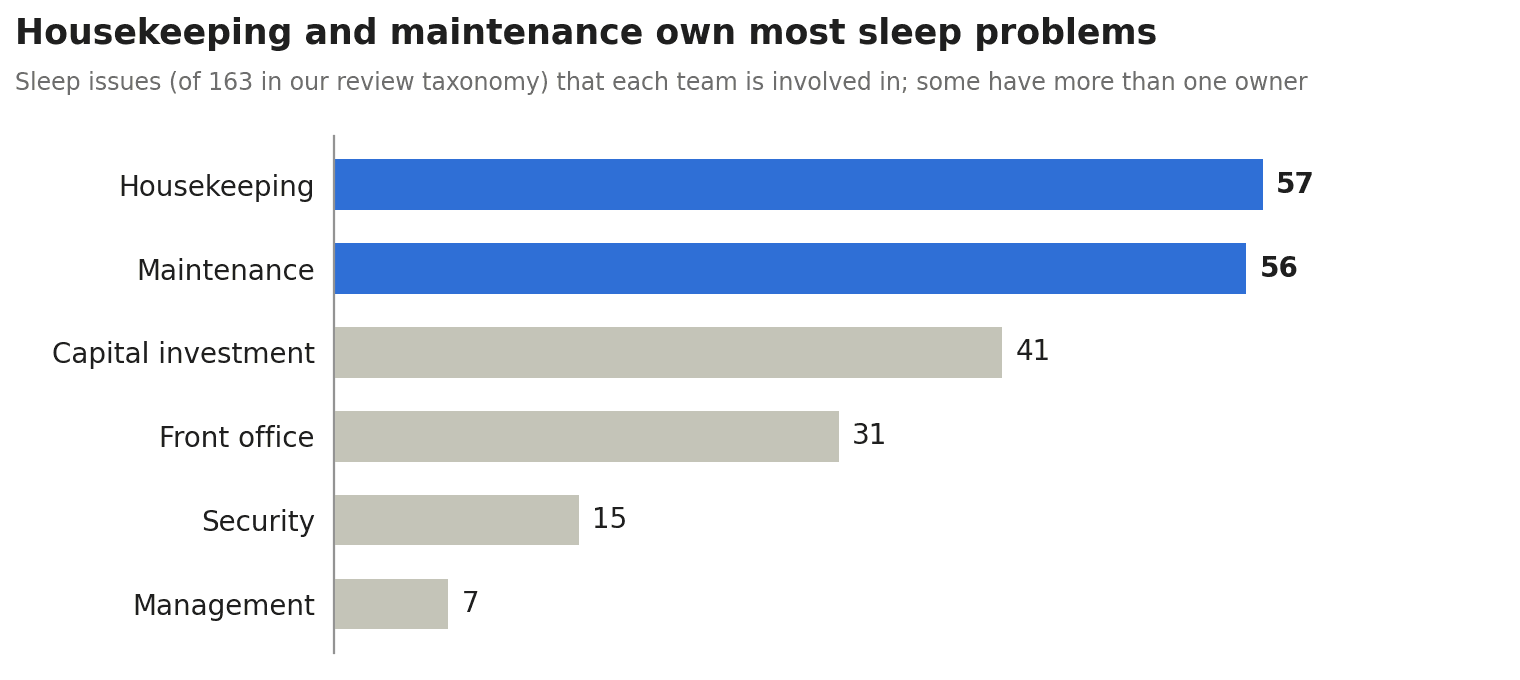
Housekeeping and maintenance own most sleep problems
Sleep Grade review taxonomy, 2026 · 163 sleep issues; an issue can have more than one owner
Capital spending concentrates in four of the 14 sleep dimensions: soundproofing, mattresses, blackout and some pillow issues. The other ten, from cleanliness and linens to thermostat control and staff behavior at night, sit entirely with your operating teams.
That matters because three of the four lowest-scoring dimensions in our Hotel Sleep Quality Report 2026 (sleep amenities, linens and thermostat control) involve no capital investment, and the fourth, pillows, only in part.
A ready-to-use sleep survey
Ask each question on a five-point scale, from 1 (very poor) to 5 (excellent). The third column shows which team owns the fix, based on our taxonomy; the overall question goes to the general manager.
| Sleep dimension | Question for guests | Team that owns the fix |
|---|---|---|
| Overall | How well did you sleep during your stay? | General manager |
| Cleanliness | Did the bed and room feel truly clean? | Housekeeping |
| Mattress | Was the mattress comfortable and supportive? | Capital investment, front office |
| Pillows | Did your pillows suit the way you sleep? | Housekeeping, capital investment |
| Linens | Did the sheets feel fresh and comfortable? | Housekeeping |
| Sleep amenities | Did you have what you needed to sleep, such as earplugs or an eye mask? | Housekeeping |
| Air-conditioning noise | Was the air conditioning or heating quiet at night? | Maintenance |
| Thermostat control | Could you set the room to a temperature you liked? | Maintenance |
| Air quality | Did the air feel fresh, not stuffy or damp? | Maintenance, housekeeping |
| Soundproofing | Were you free from noise from neighbors or the street? | Capital investment, front office |
| Corridor noise | Was the corridor quiet at night? | Front office, maintenance |
| Blackout | Could you make the room fully dark? | Capital investment, maintenance |
| Screens and lights | Were you free from glowing screens and standby lights? | Maintenance |
| Safety | Did you feel safe and secure in your room? | Security, maintenance |
| Staff at night | Did staff help you rest, for example by respecting Do Not Disturb? | Front office, housekeeping |
How to run it
1. Send it soon after checkout, with the room number. This review-based analysis works at property level. Room numbers in your survey point to problem rooms, and Sleep Grade's AI-powered monitoring platform can pinpoint them.
2. Route low scores to the owner the same day. A 1 or 2 on linens goes to housekeeping; a 1 or 2 on thermostat control goes to maintenance.
3. Review it weekly next to your online review score. Fix operating items first and log capital items for your next renovation scope.
4. Close the loop with guests. Thank respondents, and where you fixed something, say so in your review responses.
5. Show what you are doing for sleep. Display your Sleep Grade badge on your website, booking engine and corporate RFP responses, so guests can see your sleep work before they book.
Ask the question guests are already answering
Guests already judge your hotel on sleep, in their reviews and their ratings. A post-stay survey lets you hear it first, privately, and act before it shows up online.
Claim your hotel's free Sleep Grade score, compare it with your survey results, and see where your teams can act first.
Acknowledgment
Scores assess sleep-supporting conditions; the reported relationships do not establish cause and effect. The ownership map reflects Sleep Grade's review taxonomy; how teams are organized varies by hotel. This analysis is mostly review-based and works at property level; room-level findings come from Sleep Grade's AI-powered monitoring platform. Sleep scores and guest ratings both draw on guest feedback, so the link between them is an association, not proof of cause.
References
- Sleep Grade review taxonomy (2026): 163 sleep issues across 14 sleep dimensions, each assigned to the teams that typically own the fix.
- Sleep Grade Research (2026): September 30 hotel dataset; dimension averages for 29,536 hotels with at least 50 reviews in the Sleep Grade count field, and guest ratings for 29,532 of them.
- Hon and Fung (2019): A good night's sleep matters for tourists: An empirical study for hospitality professionals, Journal of Hospitality & Tourism Research.
- Robbins et al. (2021): Examining key hotel attributes for guest sleep and overall satisfaction, Tourism and Hospitality Research.
- Sleep Grade (2026): Hotel Sleep Quality Report 2026: What 40,141 Hotels Reveal.
- Sleep Grade: Methodology.

Written by Sleep Grade Research
Reviewed and Edited by Elif Polat Çorumlu, PhD
PhD in Neuroscience, Scientist in Residence, Sleep Grade
LinkedIn