Key Takeaways
Across 15,649 hotels matched to 56 brands, the brand explained about a fifth (19.8%) of the variation in sleep scores.
Inside the typical brand, the top and bottom tenth of hotels were 24 points apart, more than the 22-point gap between the best and worst brand averages.
No sleep dimension was brand-proof: brand explained 12% to 19% of the variation on each of the 14.
For owners and asset managers, most of the difference lies beyond the logo: in the property, its location and how it runs.

Article FAQ
Only partly. In our data, the brand explained about a fifth of the variation in sleep scores; the rest lies with the individual hotel, its location and factors our data can't see.
This analysis doesn't name brands. Across the 56, the gap between a brand's top and bottom tenth of hotels ranged from 16 to 37 points.
Not from this analysis, which is mostly review-based and works at property level. Sleep Grade's AI-powered monitoring platform can identify problem rooms.
No. Sleep Grade's baseline scores draw on published property information and guest-review evidence. They are separate from independently verified assessments.
Brands promise consistency: the same bed, the same standards and the same experience in every city. For sleep, our data shows how far that promise stretches.
Sleep Grade matched 15,649 review-qualified hotels from our Hotel Sleep Quality Report 2026 to 56 hotel brands by name, and asked a simple question: how much of a hotel's sleep score does its brand explain?
One-fifth brand, four-fifths everything else
About a fifth. The brand explained 19.8% of the variation in sleep scores across these hotels. Allowing for country and star rating first, the brand added a further 10.5 percentage points. The remainder reflects the individual hotel, its building, location, upkeep and night-time operations, as well as factors our data can't see.
Explained by brand
Share of the variation in sleep scores
Spread inside a brand
Typical gap between a brand's top and bottom tenth of hotels
Range of brand averages
From the lowest- to the highest-scoring brand
The pattern held across every check we ran: 19.1% using US hotels only, and 18.5% using only the 38 brands with at least 100 hotels.
Bigger gaps inside brands than between them
The typical brand's own hotels spread 24 points between their top and bottom tenth. In 39 of the 56 brands, that spread was wider than the 22-point gap between the best and worst brand averages.
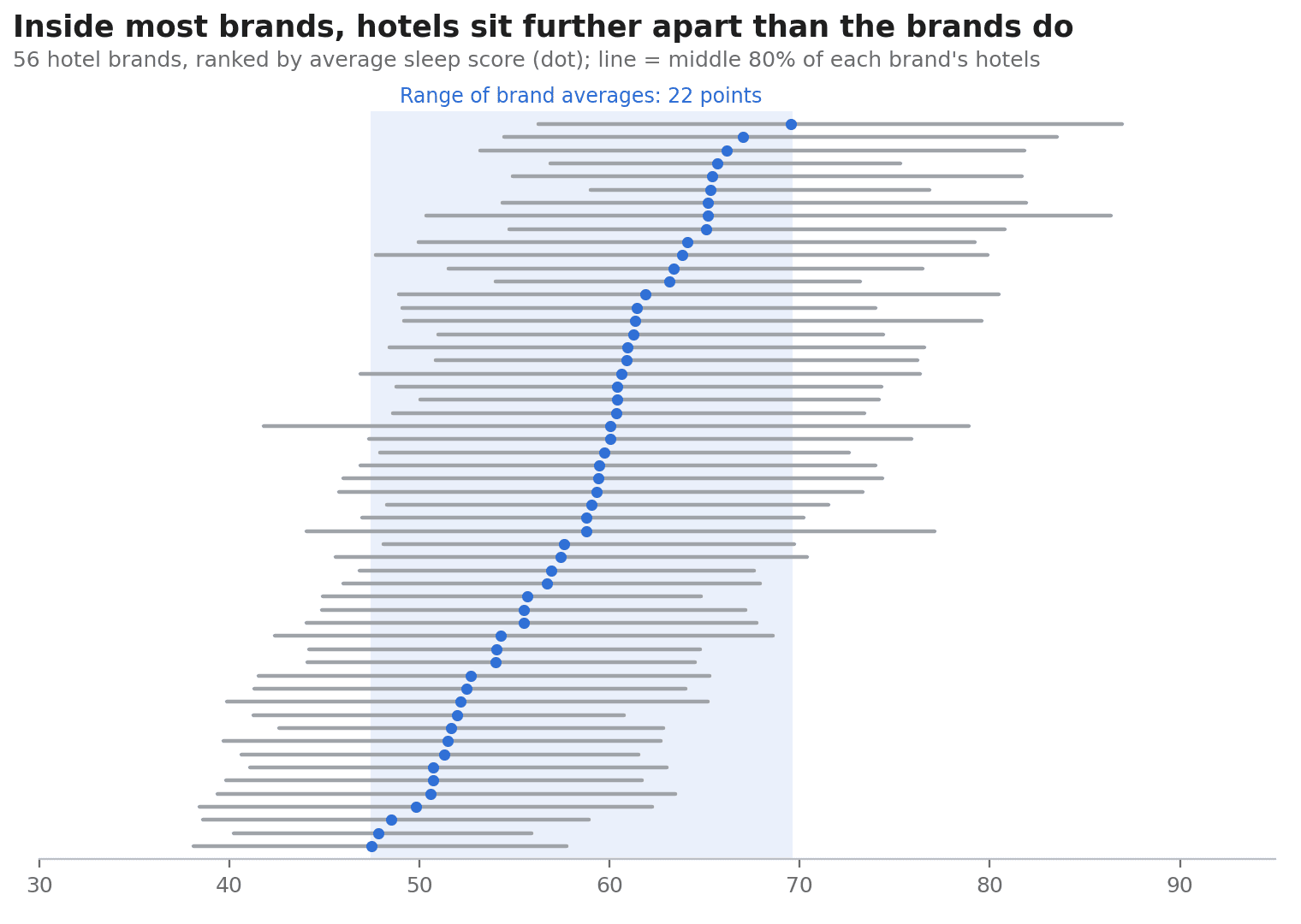
Inside most brands, hotels sit further apart than the brands do
Sleep Grade Research, 2026 · 56 brands, 15,649 hotels; brand names withheld
The overlap runs both ways. Even among the 10 lowest-ranked brands, 218 hotels outscored the median hotel of the 10 highest-ranked brands.
No sleep dimension is brand-proof
Brand explained 12% to 19% of the variation on each of the 14 sleep dimensions, from thermostat control (12%) to linens (19%). Many brands set standards for beds and bedding, yet linens, pillows and mattresses still varied mostly within brands rather than between them.
That matters because sleep shapes how guests judge a stay. A 2021 study of hotel guests found that sleep satisfaction strongly predicted overall hotel satisfaction, and a 2019 study by researchers at Hong Kong Polytechnic University found that the right sleep environment raised both satisfaction and intention to return.
What this means for owners, asset managers and brands
1. Benchmark against your brand's spread, not its average. Know where your hotel sits within its brand's range, and compare it with same-star hotels in your city.
2. Rank your portfolio by sleep dimension. For asset managers, one brand can hide a 24-point spread. Prioritize properties in the bottom tenth, and the dimensions where each one lags.
3. Audit the night, not only the room. Add noise, temperature, light and air checks to quality visits. Linens and mattresses still varied within brands, so audit them too.
4. Find the rooms behind the score. This review-based analysis works at property level. Sleep Grade's AI-powered monitoring platform can pinpoint which rooms are the problem.
5. Show your own sleep work. Display your Sleep Grade badge on your website, booking engine and corporate RFP responses, so guests see what your property does for sleep, beyond the brand promise.
A brand promises a bed. The property delivers the night.
A brand can set the standard for a bed. Whether guests sleep well depends mostly on the property: its building, its people and how it runs at night. In our data, about four-fifths of the difference lies beyond the brand.
Claim your hotel's free Sleep Grade score, see where your hotel sits within its brand's range, and act on the dimensions that lag.
Acknowledgment
Scores assess sleep-supporting conditions; the reported relationships do not establish cause and effect. Hotels were matched to brands by name, and brand names are withheld in this analysis. This analysis is mostly review-based and works at property level.
References
- Sleep Grade Research (2026): September 30 hotel dataset; 15,649 of the 29,536 hotels with at least 50 reviews in the Sleep Grade count field, matched by name to 56 brands with at least 30 hotels each. Results rounded.
- Robbins et al. (2021): Examining key hotel attributes for guest sleep and overall satisfaction, Tourism and Hospitality Research.
- Hon and Fung (2019): A good night's sleep matters for tourists: An empirical study for hospitality professionals, Journal of Hospitality & Tourism Research.
- Sleep Grade (2026): Hotel Sleep Quality Report 2026: What 40,141 Hotels Reveal.
- Sleep Grade: Methodology.

Written by Sleep Grade Research
Reviewed and Edited by Elif Polat Çorumlu, PhD
PhD in Neuroscience, Scientist in Residence, Sleep Grade
LinkedIn